
Completed Australian cohort · August 2026
What 6,313 Australian dental websites reveal about SEO readiness
DentalPresence independently tested public Australian dental-practice websites for technical foundations, patient-conversion paths, local signals, and machine-readable content, using the shared 37-check framework applied across all four markets. The results show recurring gaps in accessibility, information architecture, patient journeys, and structured practice data.
Key findings
- Among 6,313 audited Australian dental websites, the median score was 73, with only 3.69% reaching the A band and 22.40% scoring an F.
- 72.64% had no FAQ page detected (4,580 domains) — the most common patient-journey gap in the cohort.
- 62.68% had no emergency-services page detected (3,952 domains) — a high-intent search in local dentistry.
- 72.86% had images missing alternative text (4,594 domains), the most prevalent website-fundamentals gap.
- Website fundamentals was the weakest scored category, averaging 59.64.
- 13.60% of attempted domains had a DNS failure, the largest single crawl-accessibility cause. This measures our crawler's access, not Googlebot's — see methodology.
See how your own website scores
Free, takes about a minute, and you can compare your result against every practice in this study. No credit card, no sales call.
Executive finding
Usable foundations, incomplete patient journeys.
The median representative-domain score was 73, with a mean of 70.05. Only 3.69% of audited Australian domains reached the A band, while 22.40% scored an F.
Sydney (1,140 audited domains, median score 72) and Melbourne (1,061, median 72) were the largest markets in the cohort. The recurring gaps mirrored the U.S. findings: a FAQ page was not detected on 72.64% of audited domains, and images lacked alternative text on 72.86%.
Open research assets
Download and cite the study
Both files are ungated and use stable URLs. The CSV contains aggregate findings only—no practice names, domains, or per-practice records.
The main issues
Three layers account for most of the visible opportunity
Percentages below use the 6,305 uniquely audited domains resolved to a known Australian state or territory. “Not detected” means the signal was absent from the homepage and up to two linked pages in this bounded crawl; it does not prove that the signal is absent everywhere on the site.
Machine-readable signals
Structured data is hidden labelling that tells search engines and AI assistants what a page is about — your services, your address, your common patient questions. These are the labels we could not find. Adding one is not an automatic win, and it does not guarantee a fancier search listing.
AggregateRating structured data
93.72%
5,909 of 6,305 assigned audited domains
Service or treatment structured data
93.39%
5,888 of 6,305 assigned audited domains
FAQPage structured data
91.25%
5,753 of 6,305 assigned audited domains
BreadcrumbList structured data
64.30%
4,054 of 6,305 assigned audited domains
Dentist or LocalBusiness structured data
47.20%
2,976 of 6,305 assigned audited domains
Website fundamentals
The basic housekeeping of a web page — headings, descriptions, image labels — checked on the homepage and up to two pages linked from it.
Images missing alternative text
72.86%
4,594 of 6,305 assigned audited domains
Unclear H1 structure
60.84%
3,836 of 6,305 assigned audited domains
Missing meta descriptions
47.15%
2,973 of 6,305 assigned audited domains
Limited useful content on a scanned page
39.35%
2,481 of 6,305 assigned audited domains
XML sitemap not detected
31.59%
1,992 of 6,305 assigned audited domains
Missing canonical tags
31.10%
1,961 of 6,305 assigned audited domains
Patient journey and trust
The things a prospective patient looks for before they pick up the phone — how to book, what happens in an emergency, whether you take their health fund.
FAQ page not detected
72.64%
4,580 of 6,305 assigned audited domains
Insurance or payment page not detected
68.96%
4,348 of 6,305 assigned audited domains
Contact or inquiry form not detected
65.15%
4,108 of 6,305 assigned audited domains
Emergency-services page not detected
62.68%
3,952 of 6,305 assigned audited domains
Privacy-policy link not detected
59.84%
3,773 of 6,305 assigned audited domains
Clear booking action not detected
45.73%
2,883 of 6,305 assigned audited domains
Charts ready to publish
Embed the findings with source attribution intact
Each static PNG is sized for publication and includes its cohort and source. The embed control copies an image link plus a visible attribution link to this study.
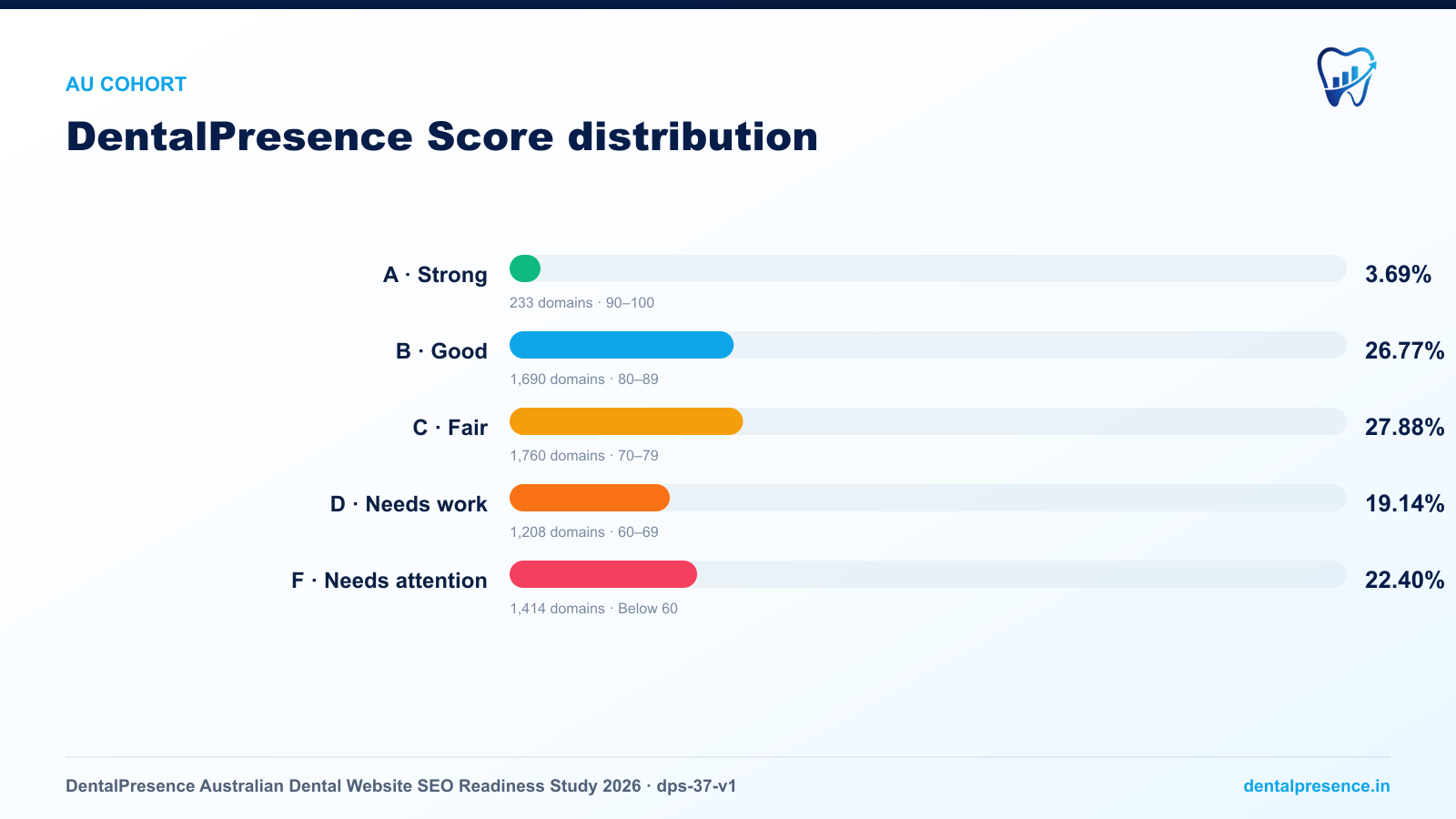
DentalPresence Score distribution
Only 3.69% reached the A band; 41.54% scored below 70.
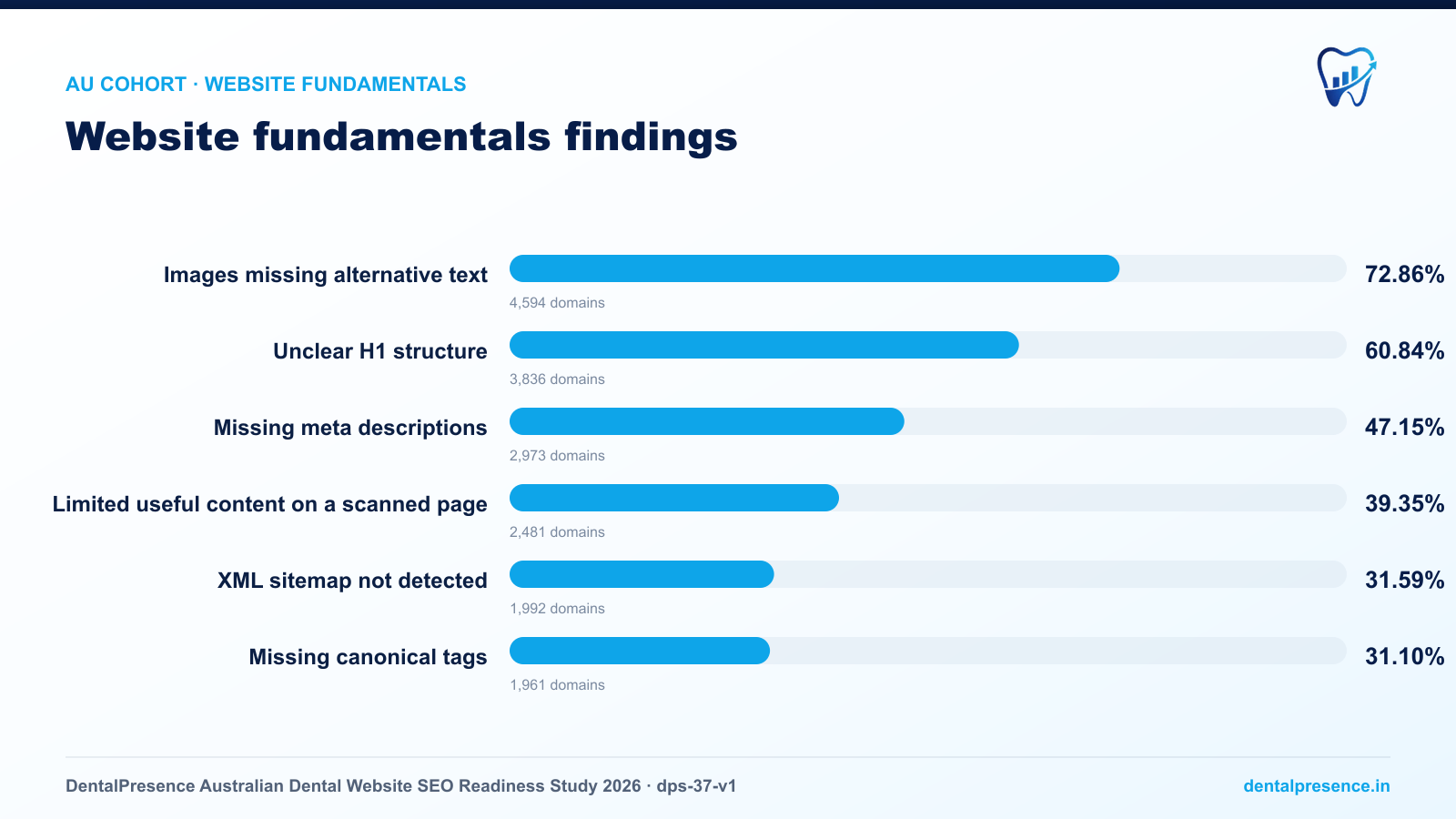
Website fundamentals findings
Images missing alt text was the most prevalent page-level gap.
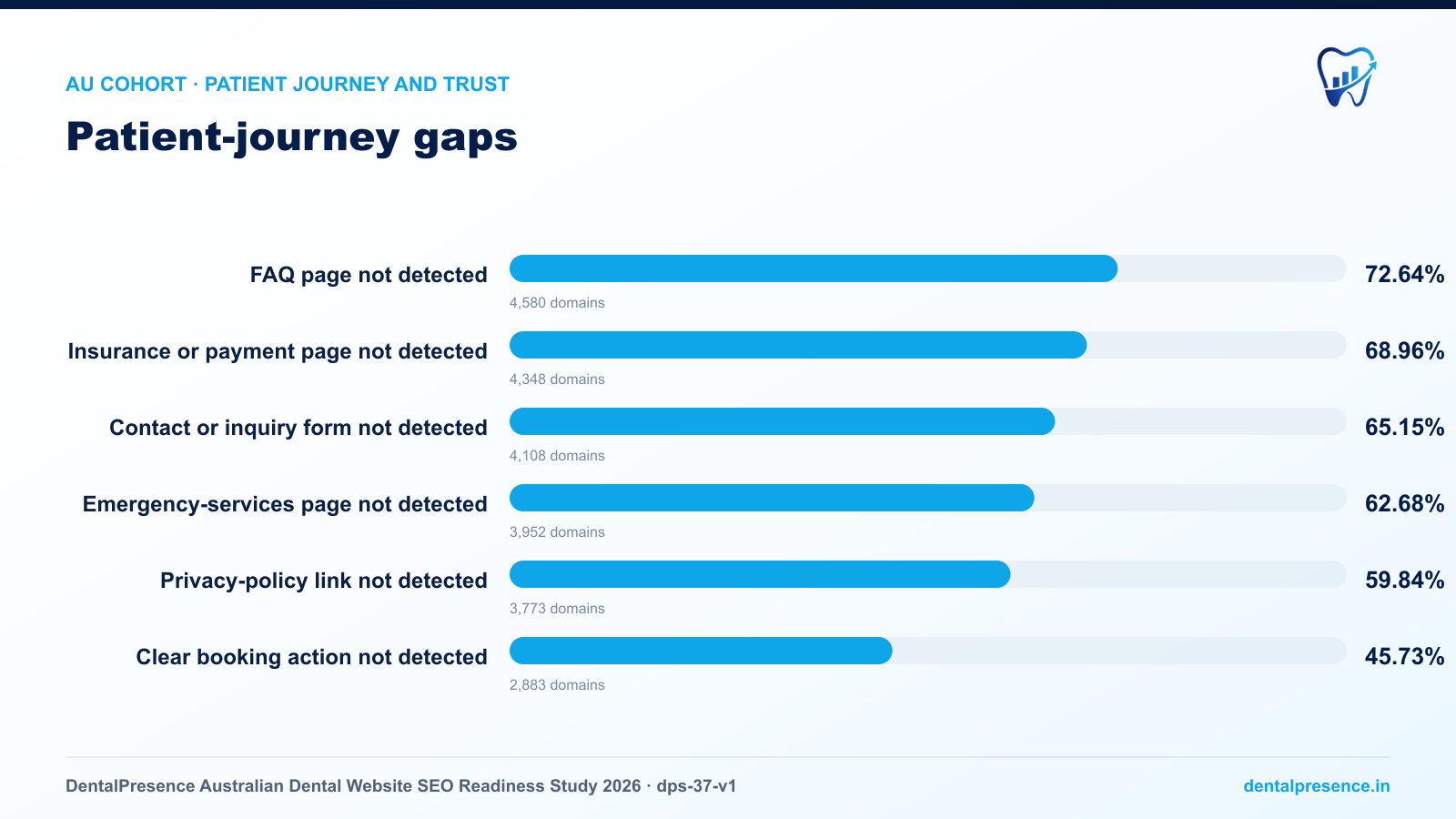
Patient-journey gaps
A FAQ page was not detected on 72.64% of audited domains.
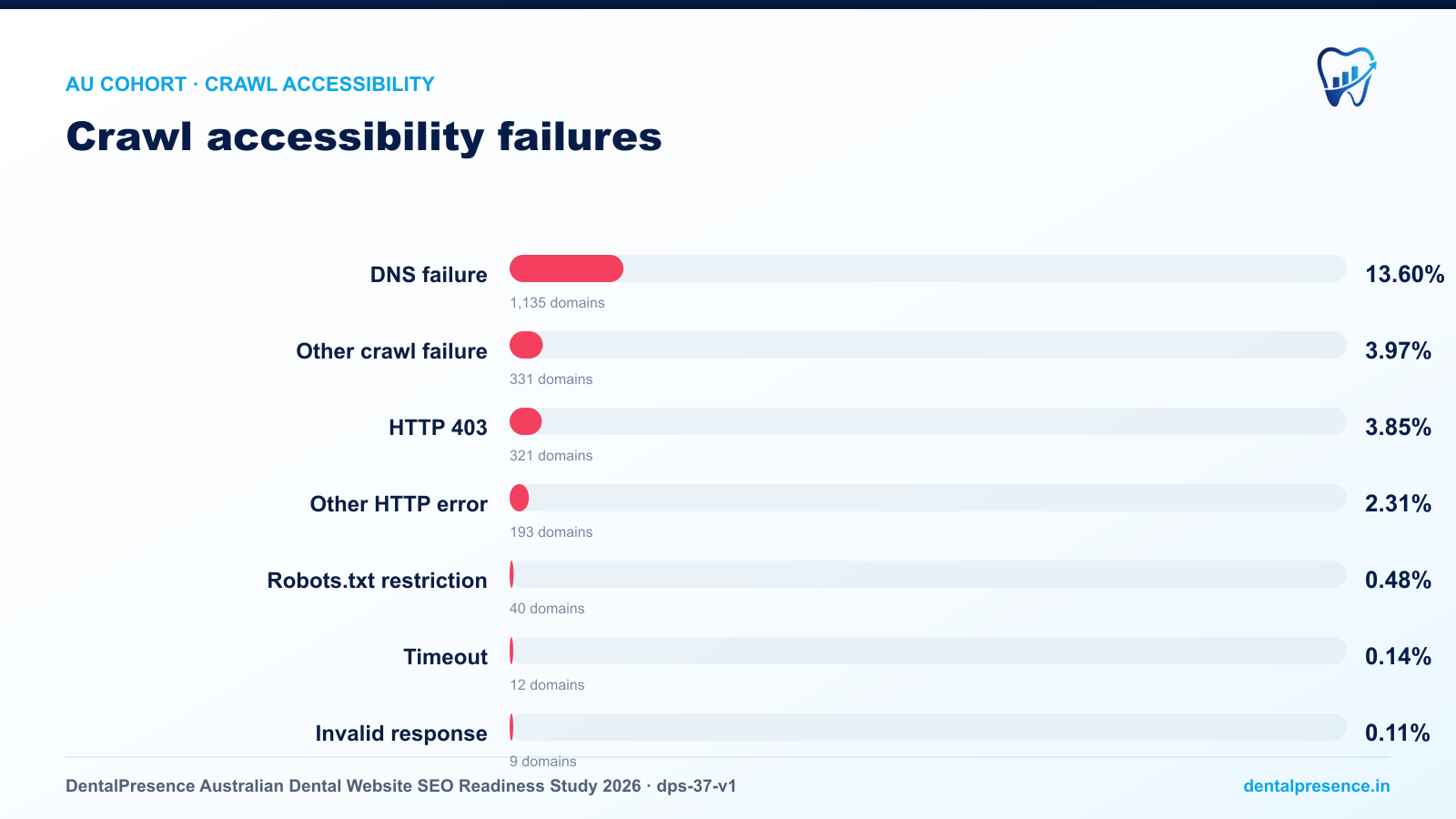
Crawl accessibility failures
2,041 of 8,346 attempted domains could not be scored.
Category view
Website fundamentals were the weakest scored category
Website fundamentals averaged 59.64, below patient trust and AI visibility. The Local SEO figure is not directly comparable because Google profile, cross-directory NAP, and service-coverage checks were intentionally not evaluated in this open-data crawl.
Website fundamentals
59.64
AI visibility
66.46
Patient trust
61.82
Local SEO*
91.86
Structured-data prevalence needs careful interpretation
Missing markup is not the same as poor rankings. Structured data must match visible page content, and Google does not guarantee a rich result even when markup is valid. FAQ rich results are generally limited to well-known authoritative government and health sites.
Google also says self-serving reviews on a LocalBusiness or Organization website are ineligible for the star review feature. Accordingly, this study reports FAQPage and AggregateRating detection rates as machine-readability observations; it does not recommend adding ineligible or misleading markup.
Before on-page SEO
One in four attempted domains could not be scored
Of the 8,346 normalized domains resolved to a known Australian jurisdiction, 6,305 completed the HTTP audit and 2,041 did not. DNS failures were the largest single cause. These failures describe reachability from the bounded crawler, not the SEO quality of the inaccessible sites.
Successfully audited
75.55%
| Outcome | Domains | All attempts |
|---|---|---|
| DNS failure | 1,135 | 13.60% |
| Other crawl failure | 331 | 3.97% |
| HTTP 403 | 321 | 3.85% |
| Other HTTP error | 193 | 2.31% |
| Robots.txt restriction | 40 | 0.48% |
| Timeout | 12 | 0.14% |
| Invalid response | 9 | 0.11% |
By state and territory
How each Australian jurisdiction compared
Every state and territory is included below at whatever sample size the cohort reached. Northern Territory's cohort (26 audited domains) is too small for a full metric-by-metric comparison — its median score is reported, but grade, category, and metric breakdowns are suppressed rather than shown on an unreliable base.
| Jurisdiction | Audited | Median score | vs. national | Reliable sub-analysis |
|---|---|---|---|---|
| Australian Capital Territory | 113 | 74 | +1 | Yes |
| New South Wales | 2,064 | 72 | -1 | Yes |
| Northern Territory | 26 | 75.5 | +2.5 | Limited sample |
| Queensland | 1,228 | 75 | +2 | Yes |
| South Australia | 399 | 71 | -2 | Yes |
| Tasmania | 104 | 69 | -4 | Yes |
| Victoria | 1,709 | 72 | -1 | Yes |
| Western Australia | 662 | 73 | matching | Yes |
Recommended sequence
A practical five-step improvement plan
Make the site reliably reachable
Verify DNS, HTTPS, redirects, robots.txt, and server or firewall rules. A practice cannot earn an on-page score when its website does not resolve or declines the bounded crawler.
Shorten the path from research to contact
Give patients visible booking, tap-to-call, and inquiry options. Link emergency, health-fund, privacy, and FAQ information from the primary navigation or footer.
Strengthen page structure and accessibility
Give every page one clear main heading, a useful title and description, plain factual descriptions on images so screen readers can read them aloud, and obvious links to your main treatment pages.
Describe the practice and its services accurately
Use page-appropriate structured data only when it matches visible content. Start with accurate practice identity and breadcrumbs; validate every implementation before release.
Measure outcomes rather than assuming them
Record a baseline in Search Console and analytics, ship a bounded set of fixes, and compare eligible impressions, clicks, enquiries, and bookings over time.
Use the study as a benchmark, not a diagnosis
A full practice audit should crawl more pages, connect first-party search data, verify listings, and review business goals before prioritizing work.
Your practice
See where your practice stands against these findings
Run a free DentalPresence Score in under 60 seconds. Compare your website against the same checks used on 6,313 Australian dental domains.
Get your free DentalPresence Score60 seconds · No credit card · Uses public practice signals
Methodology and limitations
What this study measures—and what it does not
Cohort. Two completed production runs (2026-08-23 and 2026-08-24) form this cohort. Website-level findings use one deterministic representative candidate for each domain's most recent audit across those runs, avoiding both duplicate-domain weighting and double-counting a domain audited in more than one run.
Collection window. Public pages were crawled on 23–24 August 2026 using the shared dps-37-v1 methodology. The bounded HTTP crawler inspected robots.txt, sitemap signals, the homepage, and up to two linked internal pages. Browser rendering was not used.
Scoring. The DentalPresence Score averages four deterministic category scores. Three Local SEO inputs — Google Business Profile, cross-directory NAP consistency, and service coverage — were not evaluated in this open-data cohort, so the Local SEO average is partial and upward-biased.
Unassigned domains. 19 attempted domains (8 audited) resolved to no known Australian state or territory — a missing location alias, or a source-data value outside the eight published jurisdictions — and are included in the national totals above but excluded from every per-jurisdiction cut and the issue-rate breakdowns.
Cohort size and stability. This study is a frozen snapshot of 6,313 audited domains. Market estimates should be interpreted within the published sampling limits and collection window.
Detection limits. A signal not detected in three pages may exist elsewhere, be injected only after JavaScript rendering, or use markup the parser did not recognize.
Sampling. This is a large matched open-place cohort, not a probability sample of every Australian dental practice. It should not be used to estimate national market share or infer the quality of any individual practice.
No causal claims. The study did not use rankings, traffic, conversions, clinical data, credentials, safety records, or patient outcomes. A failed check is an observable website signal, not proof of lost patients or poor care.
For journalists and researchers
How to cite this study
Copy the citation below to preserve the cohort, methodology version, and canonical source link.
DentalPresence. (2026). Australian Dental Website SEO Readiness Study 2026 (dps-37-v1): An analysis of 6,313 successfully audited Australian dental practice websites. https://dentalpresence.in/case-studies/au-dental-website-readiness-2026
Licence for these findings — The findings, charts, and data files DentalPresence publishes in this study are licensed under Creative Commons Attribution 4.0 International (CC BY 4.0). You may reproduce, adapt, and republish them, including commercially, provided you credit DentalPresence and link to this page. This licence covers the study materials only; the DentalPresence platform, software, and trademarks are governed by our Terms of Service.
Underlying data sources
This study's practice cohort was matched using the following open datasets. Each source's own licence governs its underlying place and identity data — separately from, and in addition to, DentalPresence's CC BY 4.0 licence on the findings above.
- Overture Maps Foundation — Practice location data, licensed under CDLA Permissive 2.0.
- Foursquare Open Source Places — Practice location data, licensed under Apache License, Version 2.0.
- Australian Business Register (ABN Bulk Extract) — Practice identity corroboration, licensed under Creative Commons Attribution 3.0 Australia (CC BY 3.0 AU).
Put the findings to work
Related DentalPresence Academy guides
How AI Sees Your Dental Website
Apply the study's structured-data findings to machine-readable practice content.
Read the guideSEO Myths Dentists Still Believe
Put the score distribution in context and separate observable signals from ranking myths.
Read the guide10 Online Hygiene Mistakes That Cost Dentists New Patients
Use the conversion-path gaps to prioritize practical website housekeeping.
Read the guide